For most enterprises, the first storage question is not whether to install a battery. It is what problem the battery needs to solve first. In one facility, the target is demand charge reduction. In another, it is backup power for critical loads. In a solar-heavy site, the goal may be to lift self-consumption and shift low-cost daytime energy into the evening. The reason so many projects stall is simple: buyers compare system size and price, but skip the deeper metrics that decide payback, uptime, and long-term value.
Why a Metrics-First Approach Matters
Commercial storage projects live or die on site data. Lawrence Berkeley National Laboratory notes that demand charges often make up 30% to 70% of commercial electricity bills, while NREL has found that battery economics become much stronger where tariffs combine demand charges with time-of-use pricing. Two facilities can consume similar annual electricity and still need very different storage designs if one has sharp monthly peaks and the other has long evening load.
That is why the best procurement process starts with measurable operating conditions, not with a catalog page. The seven metrics below help turn a battery purchase from a generic equipment decision into a site-specific business case.
The 7 Metrics That Matter
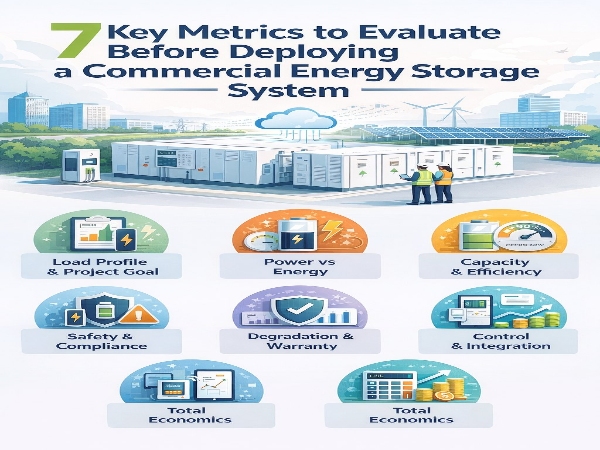
Before looking at each metric in detail, it helps to see the whole decision frame at once. High-ranking commercial storage guides keep returning to the same buying logic: start with the load profile, match power and duration, verify safety and compliance, test the economics, and only then compare suppliers.
| Metric | What your team should verify |
|---|---|
| 1. Load profile and project goal | Peak timing, spike length, seasonal pattern, critical vs non-critical loads |
| 2. Power-to-energy ratio | Required kW/MW, required discharge hours, ramp speed |
| 3. Usable capacity and efficiency | Real AC-side usable energy, depth of discharge, round-trip efficiency |
| 4. Safety and compliance | Thermal runaway testing, fire code pathway, interconnection rules |
| 5. Degradation and warranty | Cycle limits, throughput, end-of-warranty capacity, availability |
| 6. Controls and integration | BMS, PCS, EMS, solar, EV charging, generator, remote monitoring |
| 7. Total economics | Installed cost, O&M, replacement, tariff savings, resilience value |
1. Load Profile and Project Goal
The first metric is still the most important. Pull at least 12 months of interval data before anyone starts talking about battery size. The DOE’s battery evaluation method is built around long-term metered charge and discharge data, often a year or more, because real operating patterns tell far more than annual kWh totals. A cold-storage site with compressor spikes, a factory with motor starts, and an office campus with an evening peak after solar production falls off are solving three different problems.
In practice, the project goal should be written in one line before technical design begins. “Cut monthly peak demand.” “Keep the packaging line online for one hour.” “Use more rooftop PV on site.” “Support EV fast charging without a grid upgrade.” Once the goal is clear, the storage system can be sized around the right dispatch strategy instead of a vague request for backup.
Power Rating vs Energy Capacity
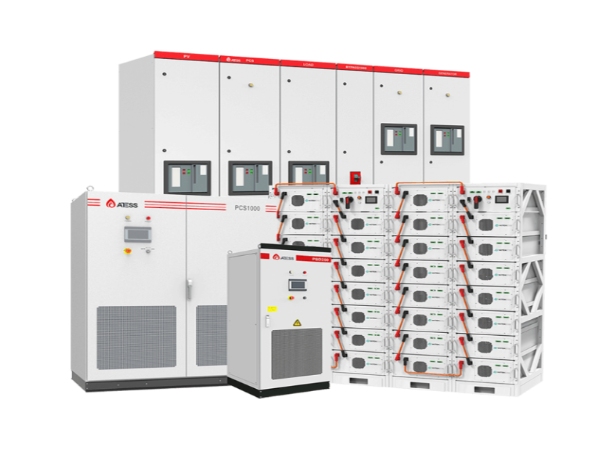
Many enterprise buyers still mix up power and energy. Power, measured in kW or MW, tells how hard the system can push at one moment. Energy, measured in kWh or MWh, tells how long it can keep going. A site that wants to clip a short monthly peak may need high power and short duration. A site shifting solar generation into the evening may need lower power but two to four hours of usable discharge.
This is where many systems get oversold. More MWh does not automatically fix a site whose real pain point is a fast 15-minute spike. On the other hand, a battery chosen only for peak shaving may disappoint if the same facility later wants longer backup or stronger solar shifting. HITEKESS’s C&I and containerized solution pages both stress modular scaling, which is the right direction: enterprises should buy a system that fits today’s duty cycle but can still grow when the site adds new loads or new revenue streams.
3. Usable Capacity, Depth of Discharge, and Round-Trip Efficiency
Nameplate capacity is not the same as usable capacity. The DOE evaluation framework focuses on demonstrated capacity and measured efficiency for a reason: the battery that looks large in a brochure may deliver less on the AC side once conversion losses, reserve margins, and operating limits are counted. Buyers should ask a simple question: how many kilowatt-hours are really available in daily operation, under the intended dispatch pattern, on the AC side of the meter?
Your uploaded material points in the same direction. It repeatedly frames lithium systems as attractive because of higher depth of discharge, stronger efficiency, longer lifespan, and lower maintenance than older battery types. That matters in enterprise settings because small efficiency gaps repeat every day, and small usable-capacity gaps become large when the battery is expected to shave peaks, shift solar, and support backup at the same time.
4. Safety, Compliance, and Thermal Risk Management
Safety review should go far beyond chemistry labels. UL says UL 9540A is the national test method used to assess thermal runaway fire propagation in battery energy storage systems, and that it is explicitly cited by NFPA 855 for large-scale fire testing. That means enterprise buyers should ask early which standards, codes, and test evidence will support permitting, fire review, and insurance conversations in the target market.
A serious safety review also covers installation design. Ventilation, thermal management, fire separation, emergency response planning, access clearance, monitoring, and utility interconnection all affect real project risk. HITEKESS’s solution pages place repeated emphasis on safety, industrial-grade protection, thermal management, and intelligent monitoring, which matches what larger buyers now expect from a deployable C&I energy storage system rather than a battery stack alone.
5. Degradation, Cycle Life, and Warranty Structure
A low purchase price can hide an expensive replacement schedule. Good procurement teams do not stop at “10-year warranty” language. They look at cycle limits, allowed throughput, end-of-warranty retained capacity, operating temperature assumptions, response obligations, and whether labor or only parts are covered. Warranty wording matters more for a daily-cycling system than for backup-only use.
This is also where dispatch strategy and battery health meet. A system used for mild evening shifting behaves differently from one driven hard every business day for demand charge reduction. HITEKESS’s site repeatedly ties its offering to long cycle life, quality control, and engineering support, and those are the right areas to probe in vendor review. The real question is not how long a battery can last in theory. It is how long it can hold value in your actual tariff and operating pattern.
6. EMS, PCS, and Site Integration
Hardware alone does not create savings. Dispatch logic does. A battery bought for peak shaving must see the site load early enough, react fast enough, and coordinate cleanly with the inverter, battery management system, energy management system, solar PV, and any EV charging or backup generation on site. Otherwise, the battery may be technically sound and financially disappointing.
This is one area where supplier capability matters a lot. HITEKESS describes smart energy management, AI-driven monitoring, remote control, project evaluation, and technical service across its C&I, containerized, and service pages. For enterprise buyers, that matters because poor controls can erase value even when the battery hardware is fine. A storage system should behave like part of the facility’s operating logic, not like an isolated box.
Total Cost of Ownership, ROI, and Resilience Value
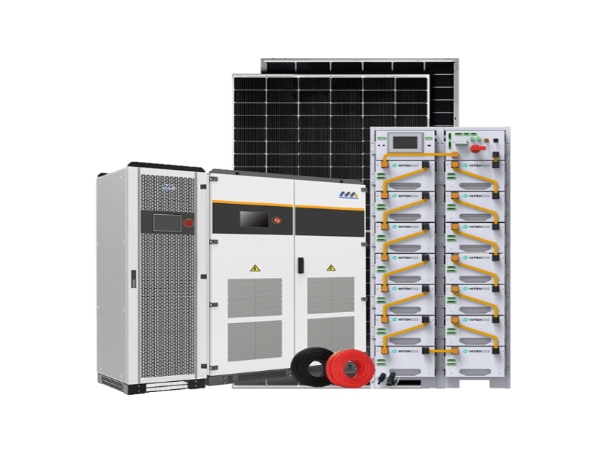
The final metric is the full business case. Installed price alone is not enough. Real evaluation should include EPC cost, switchgear or transformer work, interconnection, controls, O&M, replacement or augmentation, financing, tariff savings, and any value tied to avoided downtime. NREL’s work shows storage is especially attractive where demand charges and time-of-use pricing are strong, and resilience research shows that once outage costs are counted, the preferred battery size and breakeven point can change materially.
That last point is often missed. In a logistics center or light manufacturing plant, one avoided outage may matter more than a few points of round-trip efficiency. In a solar-rich industrial park, the strongest business case may come from stacking benefits: demand charge reduction first, then solar self-consumption, then backup value, then demand response if the local market allows it. That is the difference between a system that looks good in a quote and one that actually performs on a finance dashboard.
About HITEK ENERGY CO., LTD
For buyers looking for a C&I energy storage system manufacturer rather than a simple equipment trader, HITEK ENERGY CO., LTD presents itself as a professional energy storage products manufacturer covering lithium battery cells, modules, and system integration for commercial storage, residential storage, and backup applications. HITEKESS operates two R&D centers, uses highly automated and traceable production lines, and runs quality systems aligned with ISO 9001, ISO 14001, and ISO 45001. Across its site, HITEKESS also emphasizes tailored C&I solutions, modular design, intelligent management, technical consulting, project evaluation, customer operation guidance, and after-sales support.
@ info/ rich
The smartest storage purchase is rarely the biggest battery or the cheapest offer. It is the system whose load fit, power-duration match, usable capacity, safety pathway, warranty logic, control strategy, and financial model all line up with the site’s real operating conditions. When those seven metrics are checked in the right order, a commercial energy storage system becomes much easier to justify internally and far more likely to deliver lasting savings and stable performance after commissioning.
FAQs
What is the first thing to check when choosing a commercial energy storage system?
Start with the load profile, not the battery brochure. A commercial energy storage system should be sized around interval demand data, critical loads, tariff structure, and the exact project goal, such as peak shaving, backup power, or solar shifting.
Can a commercial energy storage system work without solar?
Yes. A commercial energy storage system can still reduce demand charges, shift energy use across tariff periods, and support backup power even without onsite PV. Solar usually adds more value streams, but it is not a requirement for storage to make sense.
How should ROI be calculated for a C&I energy storage system?
ROI should include avoided demand charges, time-of-use savings, solar self-consumption gains if PV is present, O&M, replacement or augmentation costs, financing, and the value of resilience where outages are expensive. Looking only at upfront cost will understate or distort the real return.
HITEKESS TOP SELLING C& I ENERGY STORAGE SYSTEMS
1. Hitek 3 Phase off Grid Hybrid Complete Set Solar Photovoltaic System 150kw 100kw 250 Kw Solar Power Storage System for Farm
Model: HT250KW-HY
2. Hitek Complete Set Solar Energy System 100kw 150kw 200kw 250kw 500kw Generator Battery off Grid Solar Power System Cost for Farm
Modell: HT500KW- HY
3. Hitek 50kw 100kw 100kVA 200 Kw 100 Kw on off Grid Hybrid Solar System Plug and Play Ess Complete Set Solar Energy System 200 Kwh Storage Batteries
Model: HTCI-100KW/200KWH
4. Hitek Bess 0.5MW 1MW 2MW 20FT 40FT Lithium-Ion Battery 573kwh 2150kwh Cabinet Solar Power Energy Storage System Container
Model: HT-500/2000-EC
5. Three Phase 380V 400V 200kw 250kw 500kw 1 MW 2mwh off Grid Ess All in One Commercial Lithium Battery Energy Storage System Container 20FT 40FT
Model: HT-1000/2000-EC