Plot the new operational requirement and constraints of installed system justifying expansion at commercial solar systems. Establish the frequency of additional runs for output before panels or batteries are added, determine when they will operate and on what electrical connections: as well as whether current equipment can accommodate this change. This means that roof space does not automatically translate into useful system capacity.
This is a guide for businesses adding production lines, extending shifts or readying their second phase of solar. It gives guidance on what you should include in an expansion brief and verifies the ultimate responsibility of a project engineer. Goal is to create a single solar system but with distinct boundaries between existing devices and new work.
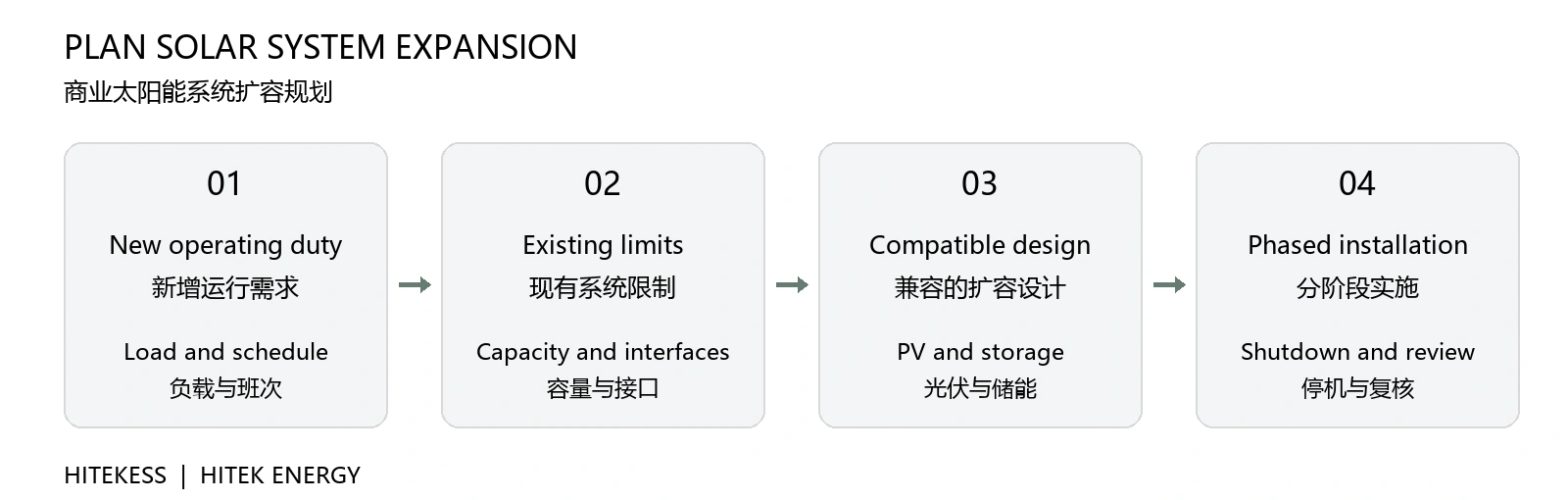
Describe the production change in operating terms
Focus on business change not how many new panels Write down the new machines, their estimated running hours and needs for simultaneous operation & startup at once. Locate loads that go to another shift and real new ones Extended operating hours can shift electricity demand as per the timings of requirement, without raising peak simultaneous load
Submit interval consumption records for the existing site, and a separate schedule of operations for the proposed operation. Weekend, maintenance shutdowns and seasonal differences are included. Maintain well-calibrated measured consumption separate from assumptions for capacity still to be installed. This allows the designer to compare a contemporary case and future iteration without conflating assumptions.
You are receiving pre-2023 data, and that is fine! For example: A new daylight assembly addition to a hypothetical factory raises one kind of planning question than if the same factory were packaging its work after-hours instead. The first potential adjustment will help to drive daytime solar generation which is a little more direct. The second requires a nighttime supply assessment, possibly storage. But neither case determines a size of battery on its own.
Establish the actual limits of the existing installation
Get the latest single-line diagram, equipment schedule, accepted connection conditions and current operational information. This is especially important if the contractor has made previous modifications not included in the drawings; ask your engineer to confirm installed condition. A very old quotation is not a good record of what still exists now. One may expect that an old quotation is not a good historical account of what are still there today
If you have an operational on-grid solar system, differentiate between the PV array rating, inverter AC rating and export limit. They describe different boundaries. Excess space on a rooftop and a low dashboard reading don’t prove spare inverter inputs, protection capacity or consent to increase export. Spare inverter inputs, protection capacity and even permission to increase export cannot be demonstrated by unused space on a roof or low readings from a dashboard
Structural suitability, array layout, equipment ratings cable routes protection and the grid connection all falls in design review. Relevant checks depend on whether installation and local specifications require them. Instead of applying a generic percent uplift to the original design, let qualified project personnel determine what assessments will be needed. More qualified people to decide what they need rather than just applying a percentage increase over original design
Choose the expansion route around the limiting factor
There are three potential paths: Increase the redundancy of existing equipment that is compatible with planned upgrades, add an alone-controlled subsystem or replace bridges and other hardware in engineering sections. Proposals need to outline the justification for its placement in regards of existing similar equipment being kept or why a particular route is well placed. A proposal must justify how its route is appropriate for the site and what equipment -if any- it retains from that already in use.
| Finding at the site | Route to investigate | Evidence needed before commitment |
| Daytime demand grows and space remains | Additional PV capacity | Layout, electrical limits and connection review |
| Demand grows mainly after sunset | Storage or another supply arrangement | Time-based energy balance and required discharge power |
| Existing equipment has no suitable expansion margin | A separate subsystem or equipment replacement | Interface design and comparison of installation disruption |
| A later production phase is uncertain | Stage the investment | Defined first-phase duty and reserved physical interfaces |
| The export allowance is constrained | Reassess generation and operating controls | Applicable connection conditions and proposed control behavior |
The following are screening questions, not design recommendations that you can apply automatically. For example, a storage addition does not relieve all grid or equipment constraints. Before you look at storage as the solution for some expansion problem in your commercial and industrial solution, re evaluate what role you want that storage to play. Before you treat storage as the solution to an expansion problem, take a close look at its intended function in your commercial and industrial model.
Verify compatibility at every old and new interface
Request documentation on the requested combinations of equipment It should also reflect on voltage ranges, current limits, communication protocols and firmware as well as supported control arrangements. Just because two things have the same brand name or nominal rating doesn’t mean that’s good enough evidence they’re interchangeable. A brand name or nominal rating is not sufficient evidence of fitness
Battery expansion needs particular care. The engineer and equipment supplier should check if the existing system also accommodates for more battery units, under what conditions. Age, configuration or maturity of use should be compared to the manufacturer requirements first. One does NOT just wire a NEW battery to an old bank; data is trained until,15/10/2023
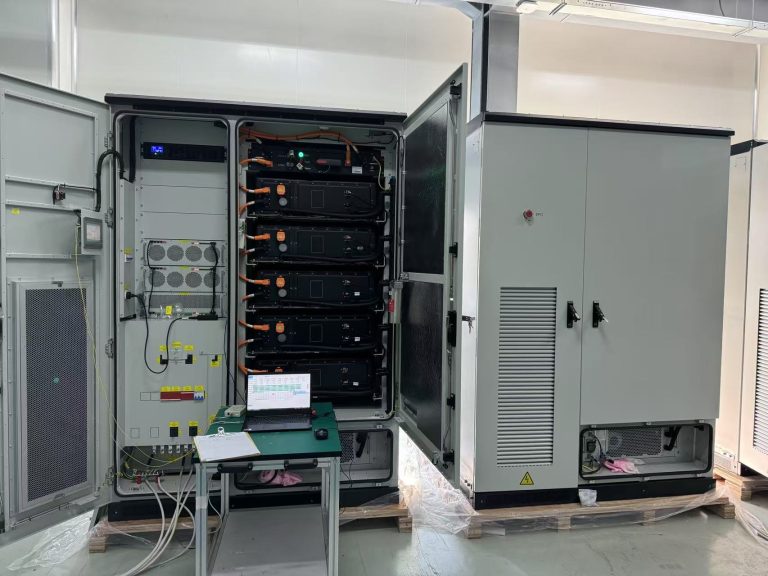
The HITEKESS hybrid solar system configuration at HITEK ENERGY illustrates how a complete systems using controllers, power conversion, batteries as well monitoring and bypass equipment. If you wish an extension, ask for a specific project arrangement detailing how the new extent lines up with your establishments. It does not claim compatibility with every existing installation (a modular product description).
Plan the work around business continuity
The best approach for an expansion proposal is to highlight areas on campus that may be able to coexist with the facility and activities that would require isolation or shutting down. Determine what loads will be affected, the period of work time available and which party needs to coordinate with (e.g., internal/external) in implementing a change. If you need temporary power, specify that. Be specific about temporary power, if you need it
Examine design and technical support in advance to clarify interfaces before you order any equipment. A phased installation sequence, a commissioning scope for the integrated setup and revised o&ms are requested. The new section itself may impact up on the existing equipment or changes to protection or controls. Modifications to each defence or controls might impacts pre-2019 ranges as well as the brand-new hiring
Establish a review point after the new production timetable has set down roots. Compare real-life load and generation records against assumptions made for design. When the next phase decision is based on observed demand and not just a calendar date, it makes for an easier staged investment process.
Prepare a concise expansion brief
Bundled relevant information from serving system description, production-change schedule along with available land availability and connection conditions. If applicable, include both required completion dates and permitted shutdown windows as well as any confirmed plans for a subsequent phase. If a drawing is missing, or unsure about a load then it should be clearly listed so that the supplier can know what needs to go and check at site.
Keep each proposal with confirmed findings separated from assumption. It should pick up retained, new and adopted equipment and the heads of interfaces as well as unresolved approvals. This provides a real-world bottom for the facilities team to evaluate whether expanding their commercial solar system makes sense and doesn:t confuse ranging an initial equipment list with finalized design. This provides the facilities team with a practical reason to review commercial solar system expansion without confusing an equipment wish list with one that has been designed.
Frequently asked questions
Can a business expand solar capacity without replacing the inverter?
A: It depends on the installed equipment and proposed design, but sometimes. Any competent designer is needed to verify the appropriate electrical limits and results of manufacturer beforehand. If the other arrangement without suitable flotation, a switch utility or substitute health supplement may make more sense. The roof area can not alone fix the decision. The decision cannot rest solely on roof area
Does a larger battery solve an increase in production demand?
A: Only if it is possible to achieve the necessary duty from a complete disposition. State of charge, discharge power and operating controls play an important role. A battery that can meet a short term demand peak may not be able to support long-term shifts. The suitability of this needs to be validated with the new load schedule. ITS USE SHOULD BE EVALUATED IN LIGHT OF THE UPDATED LOAD SCHEDULE
What should be reserved for a later expansion phase?
A:Think about physical footprint, points of access, pathways the cables can take and ports that have been documented to connect them. Electrical provisions will be decided by the engineer. Reserve Capacity Deliberately When Justifiable, But Avoid Using the Assumption of Reserved Space as Insurance Against Future Equipment Compatibility or Connection Approval When the later stage gets articulated, reevaluate those terms. Therefore, reassess those conditions when the later phase is crystallised.
Discuss the combined system before ordering equipment
When requesting a HITEKESS proposal, provide your installed configuration and expansion brief to HITEK ENERGY. Request a review at the system level where new production, which must be justified by connecting it with an existing installation along explicit lines and that produces plausible finding mechanisms for programmatically removing these assumptions, can transition in practice. Request a system level assessment that integrates the new production need with the current deploy, it should have clear conditions and an implementation roadmap.
HITEKESS BEST SELLING HIGH QUALITY COMMERCIAL SOLAR POWER SYSTEMS
- Hybrid Solar Energy Storage System 50kw 100kw 150kw 200kw 1MW 300kw off on Grid Solar System with Hitekess Lithium Battery 600kwh
Model: HTCI-300KW/600KWh
- Hitek 150kw 200kw 250kw Solar Generator Hybrid Inverter Complete Solar Energy Storage Battery System 250 Kw Whole Set with Smart BMS
Model: HT250KW-HY
- Renewable Energy Hitek Best 250kw Inverter off Grid on Grid Hybrid 50kw 100kw 150 Kw 250kw Complete Solar Power System Cost All in One Solar Panels System
Model: HT250KW-HY
- Hitek Containerized Solar System 100kw 250kw 500kw Hybrid Solar System with 500kwh 1mwh Lithium Battery 500kw 1MW Solar Battery Energy Storage System Price
Model: HT500KW-HY
- Hitekess Solar Panel Home System 100kw 100 Kw 150 Kwp 150kw 200kw Batteries Greenhouse Solar Cooling Energy System Hybrid 100kVA for Warehouse
Model: HT100KW-HY
- Hitek All in One off Grid 50kw 100kw 150kw 200kw 250kw 500kw Bess Solar Battery Energy Storage System 1MW Hybrid Solar System with Distributed Battery Cabinet
Model: HT-100/200-OC